LSR silicone overmoulding moulds: the seal moulded directly onto the part
We design and build tooling for liquid silicone rubber (LSR) injection and overmoulding. The seal, membrane or damper is moulded directly onto the part: no more post-moulding assembly, no more manual operations.
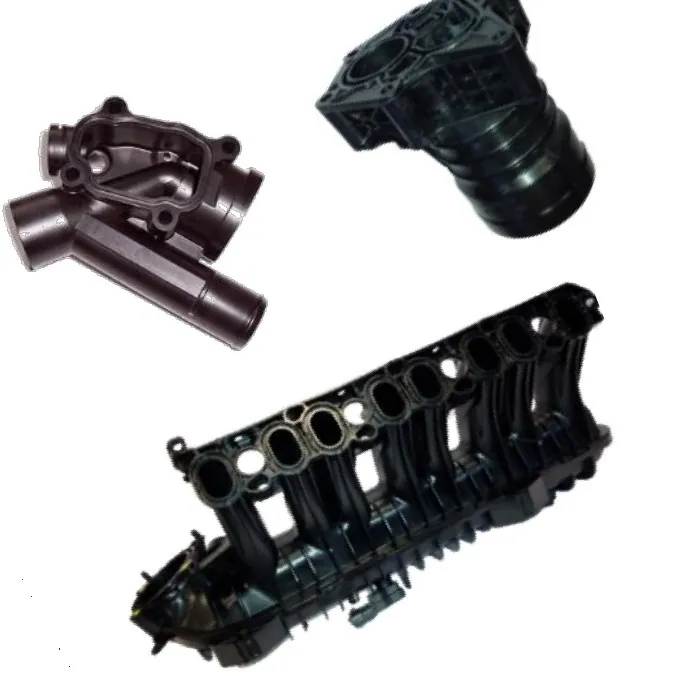
A finished part straight out of the mould
No more assembly
The seal is no longer fitted after moulding: it is injected and vulcanised onto the thermoplastic or metal substrate.
Automated production
Substrate and silicone injected within a simultaneous cycle time, with no manual rework.
No post-curing
The silicone is fully vulcanised in the tool at 180 °C, with no additional curing step.
Three temperature zones in a single mould
- 01
Thermoplastic injection
Water temperature control at 90 °C (for PA6 or PA66 GF30).
- 02
LSR silicone injection
Cold nozzle water-controlled at 20 °C: the silicone stays liquid until it reaches the cavity.
- 03
Vulcanisation
Core heated by electric cartridges to 180 °C: full vulcanisation in the tool.
- Two options: a two-component press, or a single-component press fitted with an additional injection unit.
- Vulcanisation onto polyamide (PA6 or PA66), but also onto PPS or PPA, and onto metal parts.
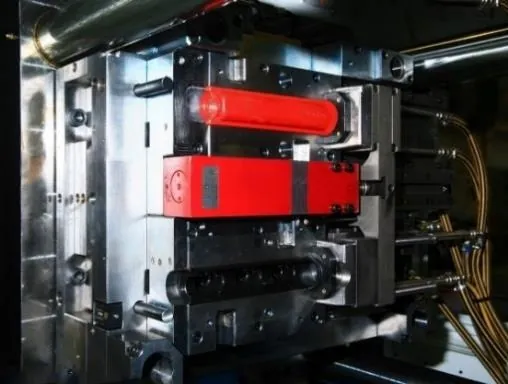
Water, air, oil, electrical
We help you choose the silicone grade to match your specification: adhesion, with or without post-curing, hardness, colour, chemical compatibility and OEM standards. Examples of grades used on our tooling:
| Application | Grade (Wacker) | Hardness | Post-curing | Specification | Colour |
|---|---|---|---|---|---|
| BSE | ELASTOSIL® LR 3023/60 | 60 Shore A | None | PSA S226106 | Blue |
| Oil filter | ELASTOSIL® LR 3016/65 | 65 Shore A | None | VW TL 52479 | White |
| Air duct and intake manifold | ELASTOSIL® LR 3005/60 | 60 Shore A | None | VW TL 52686 | Orange |
The substrate is preferably an engineering plastic (PA, PPS or PPA), so that vulcanisation in the mould avoids any post-curing.
What we bring to your project
- Support you in choosing the material and the injection press
- Improve productivity
- Enable automated production
- Ensure a simultaneous cycle time
- Reduce the scrap rate
- Design at the right cost
“From the very first shot, we saw the expertise and quality of Pernoud's tooling, even for silicone, with very little flash from the first trials.”
“Thanks to Pernoud, we eliminated fitting a seal after injection and every manual operation.”
“The overmoulded seals are the same as those we find on the market. A real plus for after-sales service.”
LSR silicone moulds: your questions
What is LSR silicone overmoulding?
Liquid silicone rubber (LSR) is injected directly onto a thermoplastic or metal part, in the same tool. The seal, membrane or damper is vulcanised in the mould: the part comes out finished, with no assembly.
Do you need a two-component press?
No. LSR overmoulding can be done on a two-component press or on a single-component press fitted with an additional injection unit.
Which materials can silicone be overmoulded onto?
Preferably on an engineering plastic such as PA6, PA66, PPS or PPA, which withstands vulcanisation at 180 °C in the mould and avoids post-curing. Overmoulding onto metal parts is also possible.
For which applications?
Seals, membranes and dampers for water, air, oil and electrical functions: housings, oil filters, air ducts and intake manifolds, for example.
A mould, a part to machine, a tool to take over?
Send us your drawing or STEP file: reply within 72 hours.